Written By. Callum Hedman, March 4, 2026
What is the Endocannabinoid System (ECS)?
The Endocannabinoid system (ECS) is a complex cell-signaling system found in virtually all vertebrates and many invertebrates, discovered in the early 1990s while researchers were studying how cannabis interacts with the body. Insects are the only major known exception, as they lack an ESC. [1]
Since research has started, scientists have learned that the ECS exists whether or not someone uses cannabis — and having a healthy endocannabinoid system plays a vital role in maintaining internal balance, or homeostasis.
“Homeostasis” refers to your body’s ability to maintain stable internal conditions (like temperature, immune balance, and mood stability) despite changes in your external environment. And here, you can read more about what the ECS does and what you can do to support your own endocannabinoid system today.
What Makes Up The ECS?
The ECS consists of three main components: endocannabinoids, which are naturally occurring compounds in your body. They act as signaling molecules that bind to cannabinoid receptors. Cannabinoid Receptors are crucial players in the system, regulating homeostasis. They act like tiny traffic controllers in your brain. They sit on nerve endings and can slow down the release of signals between neurons.
But the system doesn’t stop there. The third crucial component is enzymes. Think of them as the cleanup crew for your endocannabinoids.
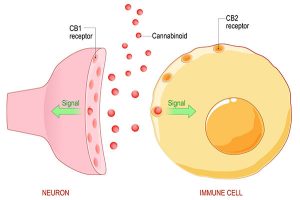
Once these signaling molecules have delivered their message to the receptors, enzymes break them down so the signals don’t stay active too long.This helps the system stay balanced, making sure your brain and body aren’t over- or under-stimulated.
Cannabinoid Receptors [2,3] (click boxes for more info, they flip!)
CB1 Receptors
Primarily found in the brain and central nervous system
CB1 Receptors help control things like mood, memory, pain, and appetite. Think of them as the brain’s “signal moderators,” keeping messages between neurons balanced.
CB2 Receptors
Primarily found in the immune system and peripheral tissues.
CB2 Receptors help manage inflammation, immune responses, and how your body reacts to injury or stress. Basically, they’re the body’s “calm-down crew,” helping tissues heal and keeping the immune system from overreacting
So, What Exactly Does the ECS Affect?
So What Exactly Does The ECS Affect?
Research shows that the ECS influences sleep cycles, mood and emotional regulation, stress response, appetite and metabolism, immune function, inflammatory response, pain perception, memory and cognition and reproductive health.
The ECS doesn’t “override these systems” so much as help modulate them, assisting in adjusting signals to maintain stability.
Some researchers have proposed a theory called Clinical Endocannabinoid Deficiency (CECD), suggesting low endocannabinoid tone may be linked to certain chronic conditions such as migraine, fibromyalgia, and irritable bowel syndrome. However, this theory is still being researched.
Because the ECS is regulatory, its health is reflected in overall balance.
(click the boxes for more info)
Signs of a Healthy ECS
A healthy, happy, and supported endocannabinoid system can come with a ton of benefits, both physical and mental. A good way to support your ECS is through exercise, but some people may describe getting the best results from CBD!
Some signs that your ECS is functioning well are:
Stable moods,
Restful sleep,
Healthy stress responses,
A balanced appetite,
And an appropriate inflammatory response.
Signs of an Unhealthy ECS
Some research suggests that an unhealthy endocannabinoid system can be linked to chronic conditions such as migraines, fibromyalgia, irritable bowel syndrome, and more. [4]
Some possible signs of ECS dysregulation are:
Sleep disturbances,
Heightened stress response,
Mood fluctuations,
Chronic discomfort,
And digestive irregularity.
It’s important to note that research is ongoing, and the ECS is still being actively studied.
How Can You Support Your Endocannabinoid System Today?
While research continues to evolve, several lifestyle practices appear to support ECS balance[5]:
1. Regular Exercise
Exercise may increase natural endocannabinoid levels — contributing to the well-known “runner’s high.”
2. Quality Sleep
Consistent sleep supports hormonal and neurological balance.
3. Stress Management
Chronic stress may disrupt endocannabinoid tone.
4. Nutrition
Healthy fats (like omega-3 fatty acids) are important for endocannabinoid production.
5. CBD (Cannabidiol)
CBD does not bind strongly to CB1 or CB2 receptors. Instead, research suggests it may influence the ECS indirectly — including inhibiting the breakdown of anandamide, one of the body’s natural endocannabinoids.
Unlike THC, CBD does not produce intoxicating effects.
Many people choose high-quality CBD products as part of a broader wellness strategy to support ECS function.
The Endocannabinoid System is one of the body’s most important regulatory networks. It plays a central role in maintaining balance across many systems, and as science continues to evolve, understanding and supporting the ECS may become an increasingly important part of proactive wellness. And we may be bias, but we have some of the best, high-quality products on the market to help support your ECS today.

BALANCE Hemp Extract CBD Tincture (CBD Oil)

Silk CBD Pain Relief Body Butter

FLEX™ 750mg Muscle & Joint Capsules

Noah's Ark Pet™ CBD Pet Health Formula

CBD Fruit Chews

Seventh Day Aluminum Free Deodorant
Sources
[1] Silver, Robert J. “The Endocannabinoid System of Animals.” Animals, 2019, https://pmc.ncbi.nlm.nih.gov/articles/PMC6770351/
[2]Mechoulam, Raphael, and Lee A. Parker. “The Endocannabinoid System and the Brain.” Annual Review of Psychology, 2013, https://pubmed.ncbi.nlm.nih.gov/22804774/
[3]Howlett, Allyn C., and Mary E. Abood. “CB₁ & CB₂ Receptor Pharmacology.” Advanced Pharmacology, 2017, https://pmc.ncbi.nlm.nih.gov/articles/PMC5812699/
[4]Russo, Ethan B. “Clinical Endocannabinoid Deficiency Reconsidered: Current Research Supports the Theory in Migraine, Fibromyalgia, Irritable Bowel, and Other Treatment-Resistant Syndromes.” Cannabis and Cannabinoid Research, 2016, https://pubmed.ncbi.nlm.nih.gov/28861491/
[5]Zou, Shuhua, and Uday Kumar. “Cannabinoid Receptors and the Endocannabinoid System: Signaling and Function.” International Journal of Molecular Sciences, 2018, https://pubmed.ncbi.nlm.nih.gov/29533978/
Lu, H.-C., and Ken Mackie. “An Introduction to the Endogenous Cannabinoid System.” Biological Psychiatry, 2016, https://pubmed.ncbi.nlm.nih.gov/26698193/