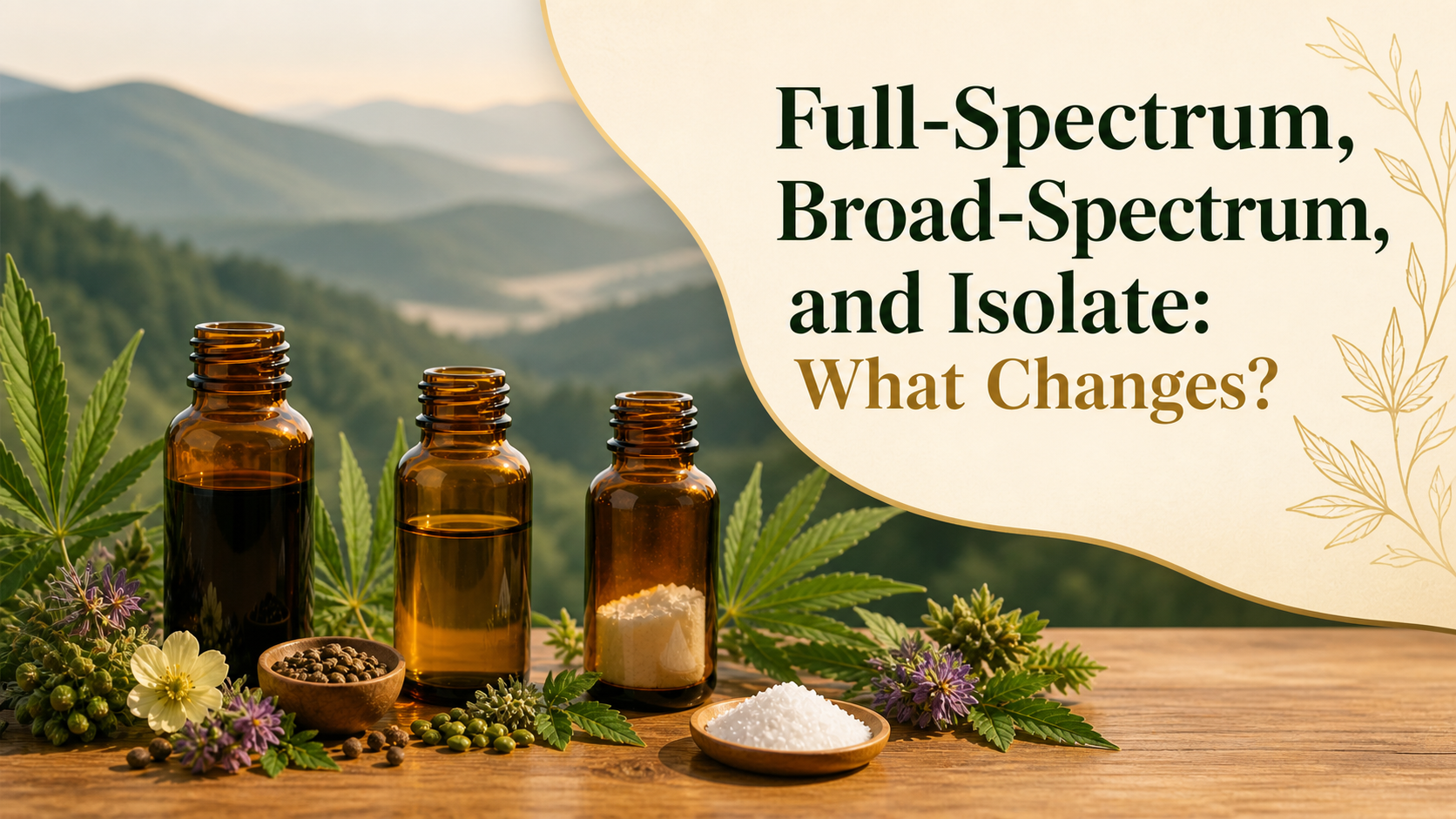
CBD Extract Types – Introduction
CBD labels often use three familiar terms: full-spectrum, broad-spectrum, and isolate. Those words describe what remains after hemp moves through extraction and refinement. They do not rank products from best to worst. Instead, each term offers clues about the cannabinoid profile, possible THC content, flavor, and testing information a shopper should review.
The names can still create confusion. Two products may use the same category while showing different laboratory results. Manufacturing methods and reporting limits also vary. A careful shopper therefore reads the category, ingredient panel, cannabinoid amount, and batch report together. This guide explains what usually changes between the three choices and what does not.
Start with the Hemp Plant, Not the Marketing Term
Hemp produces CBD alongside many other natural compounds. These include minor cannabinoids, aromatic terpenes, flavonoids, waxes, and plant pigments. Extraction collects some of that material. Later processing removes selected components and concentrates others. The final composition depends on the starting plant, extraction method, refinement steps, formulation, and quality controls.
Federal law defines hemp by its delta-9 THC level on a dry-weight basis. That legal definition does not guarantee that every finished product has an identical cannabinoid profile. It also does not prove label accuracy. The National Center for Complementary and Integrative Health notes that retail cannabinoid products may contain different amounts than their labels suggest. Independent batch testing therefore remains important. [1]
What Full-Spectrum Usually Means
Full-spectrum extract generally keeps CBD with a wider group of hemp compounds. The finished extract may include minor cannabinoids, terpenes, and legally permitted trace THC. Keeping a broader profile is the main feature. The exact mixture can still differ between plant varieties, batches, extraction systems, and finished formulas.
Some people discuss an “entourage effect,” meaning several plant compounds may work together. That idea remains an active research subject. It should not become a promise that every full-spectrum product works better. Product strength, individual response, route of use, and the actual measured profile all matter. Evidence for many retail wellness claims remains limited.
Trace THC deserves attention when drug screening matters. A lawful hemp product can still contain a measurable amount. Repeated use may increase exposure. No front-label phrase can guarantee a specific workplace or athletic test result. Review the matching certificate of analysis and speak with the relevant testing authority when the consequences are serious.
What Broad-Spectrum Usually Means
Broad-spectrum extract also preserves more than CBD alone. Manufacturers typically reduce or remove THC while retaining selected minor cannabinoids and other hemp compounds. This creates a middle option between a wider full-spectrum profile and purified CBD isolate. However, broad-spectrum is not a single standardized recipe across every company.
Labels may describe THC as removed, THC-free, or non-detectable. Those phrases require context. “Non-detectable” means a laboratory did not find THC above its method’s reporting threshold. A different method may have another threshold. Shoppers should check the actual result, units, detection limit, batch number, and testing date instead of relying only on bold package wording.
Broad-spectrum products can suit shoppers who want several cannabinoids while trying to limit THC exposure. They still require the same careful review as other products. Ingredients, CBD amount, serving information, current laboratory results, and responsible directions remain more useful than category language alone.
What CBD Isolate Usually Means
CBD isolate is a highly refined ingredient in which cannabidiol makes up nearly all the cannabinoid material. Processing removes most other plant compounds. The result is usually neutral in flavor and easier to formulate consistently. Isolate may appear in capsules, topical products, oils, or other formats that call for a narrow cannabinoid profile.
A simpler profile does not make isolate automatically stronger, safer, or more effective. It only describes composition. Product quality still depends on accurate measurement, suitable ingredients, clean handling, storage, and laboratory confirmation. People also respond differently, so extract type alone cannot predict an individual experience.
Isolate may appeal to shoppers seeking CBD without a broader cannabinoid mixture. Even then, anyone facing drug testing should avoid absolute assumptions. Manufacturing controls and laboratory sensitivity matter. Review a current report and consider the consequences before choosing any cannabinoid product.
The Main Differences at a Glance
Full-spectrum usually provides the widest plant profile and may contain trace THC. Broad-spectrum generally retains several compounds while reducing THC below a stated level. Isolate focuses almost entirely on CBD. These are useful descriptions, but they are only the beginning of a responsible comparison.
Flavor can change because terpenes and other plant material influence taste. Color and aroma may also differ. The category can affect the cannabinoid panel shown on a COA. It does not determine the delivery format. Tinctures, capsules, chews, and topicals may use different extract types depending on the formula.
Read the COA Before Choosing
A certificate of analysis, or COA, reports findings from a tested sample. Start by matching the product name and lot number. Then confirm the laboratory date and measured CBD amount. Review THC, minor cannabinoids, units, and reporting limits. When available, contaminant panels add information about pesticides, solvents, microbes, or heavy metals.
Green Mountain Hemp Company maintains an Analysis and COA library for several product groups. Use the report connected to the product and batch you plan to purchase. An older report from another lot cannot describe every detail of the container in your hand.
Compare Real Product Examples
The company’s complete CBD product collection shows how extract type appears across different formats. Look beyond the category name and compare cannabinoid amounts, directions, ingredients, and laboratory support.
BALANCE Hemp Extract CBD Tincture represents a tincture format built around hemp extract and carrier oil. A tincture requires attention to bottle strength, serving information, and dropper directions.
REGENERATE THC-Free Broad-Spectrum Soft Gels provide a premeasured capsule format. Their product page helps illustrate why broad-spectrum wording should be reviewed with ingredients and current testing.
CBD Fruit Chews show another convenient format using a stated amount per piece. Chews also require attention to sweeteners, storage, serving directions, and secure storage away from children.
Safety Does Not Change with the Category Name
Full-spectrum, broad-spectrum, and isolate products can all raise safety questions. CBD may affect alertness, digestion, mood, liver function, and how some medicines work. THC exposure adds separate concerns. The FDA advises consumers to discuss CBD use with a healthcare professional, especially when medications or health conditions are involved. [2]
Avoid CBD during pregnancy or breastfeeding, following federal guidance. Keep every cannabinoid product away from children and pets. Do not combine several products without considering total exposure. Stop using a product and seek qualified guidance when unwanted effects appear. CBD should never delay diagnosis or proven medical care.
How to Choose without Guessing
Begin with your reason for considering CBD and your preferred format. Decide whether trace THC matters for employment, athletics, travel, or personal preference. Read the entire label. Match the product with its current COA. Compare measured cannabinoids rather than relying on marketing adjectives. Finally, ask a healthcare professional about medication interactions or individual risks.
Price should not become the only deciding factor. Compare the CBD amount in each serving, the number of servings, and the usable format. A lower-priced bottle may provide less CBD or fewer servings. A higher price does not prove stronger quality either. Transparent details make value easier to judge than package design or promotional language.
Common Misunderstandings to Avoid
One common mistake is treating broad-spectrum as guaranteed zero THC. Laboratory language is more precise than that promise. Another is assuming full-spectrum always produces intoxication. Lawful hemp products contain limited delta-9 THC, but individual exposure and testing concerns still matter. The COA provides better evidence than general assumptions about either category.
Shoppers may also assume isolate is synthetic. CBD isolate can be refined from hemp-derived extract. Refinement separates cannabidiol from most accompanying compounds. The finished ingredient may look very different from the plant, yet its origin can still be botanical. The product page and supporting documents should explain the ingredient source clearly.
Another misunderstanding involves strength. A full-spectrum product is not automatically stronger than isolate. Strength usually refers to the measured CBD quantity or serving amount. Spectrum describes composition. A low-strength full-spectrum tincture and a high-strength isolate product answer two separate questions. Read both the cannabinoid profile and milligram information before comparing them.
Give One Product Time and Attention
Changing products every day makes comparisons difficult. If a healthcare professional agrees that CBD is appropriate, choose one transparent product and follow its directions. Keep short notes about timing, labeled serving, and unwanted effects. Avoid increasing the amount simply because the experience feels subtle. More CBD does not guarantee a better response.
Review the routine whenever the product, medications, or health situation changes. A different extract can introduce another cannabinoid profile. Combining formats may also increase total CBD exposure without making that increase obvious. Careful records support better questions and safer conversations with a qualified professional.
Storage deserves attention as well. Heat, direct sunlight, moisture, and repeated exposure to air can affect product quality over time. Follow the package instructions and keep the container tightly closed. Check the expiration or best-by date before use. Do not transfer CBD into an unlabeled container, because the original package carries serving, ingredient, warning, and batch information needed for responsible use.
There is no universally best extract type. Full-spectrum offers a wider hemp profile. Broad-spectrum aims to preserve variety while limiting THC. Isolate provides the narrowest cannabinoid composition. The right comparison depends on transparent facts, practical needs, and careful expectations. Live the Way Nature Intended.