
Written by Callum Hedman
Date Published: July 14, 2026
CBD For Pets - Introduction
One of the worst things a pet parent can hear is that their furry friend has cancer. After such a diagnosis, people look for ways to improve their pet's comfort and quality of life. Recently, more reports claim that home remedies, especially cannabis and cannabinoids, offer benefits to cancer patients—both human and animal. These accounts sound hopeful but often contain confusing and contradictory information. This makes it hard to know what evidence is trustworthy. This blog will look at what science says about cannabis and cannabinoids for pet cancer. It will discuss types of cannabis products, review key research findings, and highlight what pet owners should consider before giving their pets cannabis.
To better understand the conversation, it helps to know a little about cannabis and the compounds it contains. Cannabis plants produce over 150 naturally occurring compounds known as cannabinoids, including CBD and THC.[1] These cannabinoids interact with receptors throughout the body that help regulate functions such as mood, appetite, pain signaling, immune response, and more. It is commonly used medicinally for humans to ease medicinal side effects, ease pain, help promote better sleep, and even to replace conventional medicinal treatments. [8]
When talking about cannabis products, it's important to understand the differences between hemp and marijuana. Industrial hemp contains 0.3% THC or less and is commonly used to create products that can be purchased legally online or through retail stores in America. Marijuana contains more than 0.3% THC and is typically available through licensed cannabis dispensaries in states where recreational cannabis use is legal.[2]If you live in Vermont, there is no legal risk to using pet-safe cannabis on your animals. It is important to speak with a vet about the benefits and risks first. They cannot legally prescribe CBD; however, they can provide invaluable information about it. In other states or countries, it is important to look up your local laws. To check whether cannabis products are legal for pets where you live, you can ask your veterinarian, contact your state's veterinary medical board, or reach out to local government offices. Many state or local government websites also provide information about regulations for pet cannabis products. Checking these sources helps ensure you are making safe and legal choices for your pet.
How Can CBD Help Your Pet? What The Science Shows Right Now
Research into cannabinoids and cancer has grown significantly over the past decades. Over 100 scientific studies have examined the potential anticancer effects of cannabinoids like CBD and THC. Some terpenes, the compounds responsible for the cannabis plant's aroma, have also shown potential anticancer activity in labs.[3] These studies suggest cannabinoids may influence cancer cells by slowing tumor growth and spread, encouraging programmed cell death, and regulating inflammation.[4] However, many of these studies have been done in cell or animal models and may not reflect the complexities of cancer development or treatment in living pets or humans. Therefore, findings should be viewed with caution until further research, especially well-controlled clinical trials, confirms these effects in real-world veterinary or human medicine.While these findings are promising, there is still insufficient evidence to determine the most effective cannabinoid types, combinations, or dosages for treating cancer in dogs or cats. More veterinary-specific research is needed before recommendations can be made.
While these findings are promising, there is still insufficient evidence to determine the most effective cannabinoid types, combinations, or dosages for treating cancer in dogs or cats. More veterinary-specific research is needed before recommendations can be made.
Where cannabinoids may currently have the greatest potential is in supporting comfort and quality of life for pets undergoing cancer treatment. Published studies and clinical observations suggest cannabis may help manage symptoms commonly associated with cancer or conventional therapies, including nausea, pain, anxiety, and reduced appetite.[5] Research has also shown that both hemp-derived and marijuana-derived cannabinoid products are generally well tolerated in dogs and cats. However, additional studies are needed to establish optimal dosing protocols for pets with cancer.[6]
As with any other supplements, there are important concerns to discuss with your veterinarian. Cannabinoids may increase heart rate or affect heart rhythm, so pet owners should talk with their veterinary provider before giving cannabis products to animals with heart-related issues. Some cannabinoids, particularly at higher doses, may also have immunosuppressive effects, which is why you must speak with your veterinary care provider about concerns before looking into using cannabis products.
Product Suggestion
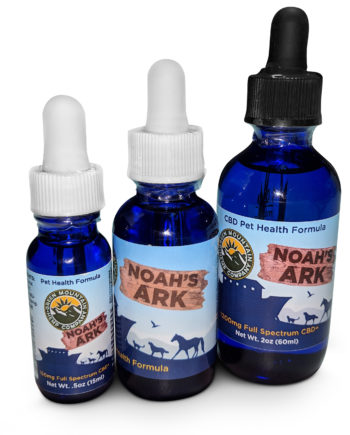
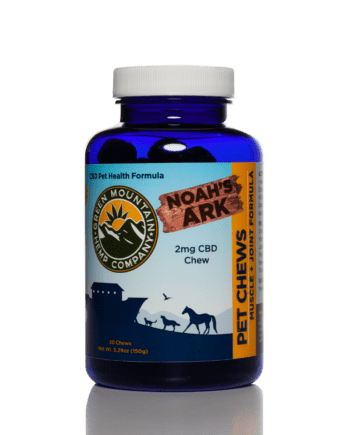
At Green Mountain Hemp Company, we have high-quality, safe products that some of our employees even use on their pets. We have a few different products, including CBD dog chews, pet CBD tinctures to add to food, or pet skin and coat sprays. Choosing what is right for you and your pet comes down to when you prefer to give it to them, how, and what you’re looking to help relieve. The 2mg CBD dog chews are perfect for active day outings with your dog, where the tincture might be a hassle, while the tincture is perfect for routines. Putting the right amount into your pet’s food is also a common way to give your pet the medication. The spray is great for itchy, dry skin and dandruff, as well as rejuvenating their beautiful, soft coat. As a safe rule, you should always start with a low dose with your pets, about 1mg per 10lbs, but your veterinary care provider will have better information on how much your pet could be taking.
-

Noah’s Ark Pet™ CBD Pet Health Formula
Price range: $19.99 through $59.99 — or from Price range: $17.99 through $53.99 / month Select options This product has multiple variants. The options may be chosen on the product page -
Noah’s Ark Pet Chews | Muscle + Joint Formula For Pets
$39.99 — or Original price was: $39.99.$35.99Current price is: $35.99. / month Select options
Feel free to take a look at the wonderfully high quality options on our site, or add one of these lovely items to your cart now!
Risks to Consider
A THC overdose in animals can produce harmful effects such as incoordination, drooling, sedation, paranoia, anxiety, restlessness, and even urinary issues. A veterinarian should advise the pet parent on monitoring their animal and whether a pet may require hospitalization. [7] If you start to see signs of a THC overdose in your pet, it is important to take them to your nearest veterinary clinic or emergency care clinic. If none of this is possible, keep a constant eye on your pet, pay attention to temperature, as animals may begin to feel cold or even succumb to hypothermia during a THC overdose. Prevent the dog from choking, keep them calm, and do not force-feed or try to force them to drink water, as this can cause them to inhale the water or food. Also, keep an eye out for vomiting, as they may inhale it while sedated. Another good way to support your pet is sensory deprivation, as a THC overdose can cause sensitivity to lights, sounds, and sensations. Avoid excessive petting, and put them in a dark room with a carpet and nothing to fall into or off of, as their balance may be off as well. However, you must do what you can to get to a veterinary hospital.
The Conclusion on Cannabis and Cancer Research
While research into cannabinoids and cancer is still new and evolving, early studies are showing promising results. At this time, cannabinoids are most commonly used to relieve symptoms such as pain, nausea, anxiety, and poor appetite, and support better comfort through their health struggles. As scientists continue to learn more, pet owners should work closely with their veterinarian to discuss potential benefits and health risks, and to decide whether cannabis products may be an appropriate addition to their pet's care plan.
Citations
Monti, Manuela Carla, et al. "Beyond Δ9-tetrahydrocannabinol and cannabidiol: chemical differentiation of cannabis varieties applying targeted and untargeted analysis." Analytical and Bioanalytical Chemistry, vol. 414, 2022. https://doi.org/10.1007/s00216-022-04026-2 [1]
Team, LegalClarity. "Industrial Hemp: Federal Law, Licensing, and Compliance." LegalClarity, 2026. https://legalclarity.org/industrial-hemp-federal-law-licensing-and-compliance/ Accessed June 2, 2026 [2]
Tomko, Andrea M., et al. "Anti-Cancer Potential of Cannabinoids, Terpenes, and Flavonoids Present in Cannabis." Cancers, vol. 12, no. 7, 2020. https://doi.org/10.3390/cancers12071985 [3]
Guzmán, Manuel. "Cannabinoids: potential anticancer agents." Nature Reviews Cancer, vol. 3, 2003. https://doi.org/10.1038/nrc1188 [4]
Lima, Tácio de Mendonça, et al. "Use of cannabis in the treatment of animals: a systematic review of randomized clinical trials." Animal Health Research Reviews, vol. 23, no. 1, 2022, pp. 25-38. https://doi.org/10.1017/S1466252321000189 [5]
Bookout, William, et al. "Safety study of cannabidiol products in healthy dogs." Frontiers in Veterinary Science, vol. 11, 2024. https://doi.org/10.3389/fvets.2024.1349590 [6]
Cohen, Aly. "Cannabis (THC) intoxication in dogs." Cornell University College of Veterinary Medicine, 2025. vet.cornell.edu Accessed June 2, 2026 [7]
Sinikka L Kvamme, et al. "Exploring the use of cannabis as a substitute for prescription drugs in a convenience sample." National Library of Medicine, 2021 https://pmc.ncbi.nlm.nih.gov/articles/PMC8272272/ Accessed June 12, 2026 [8]
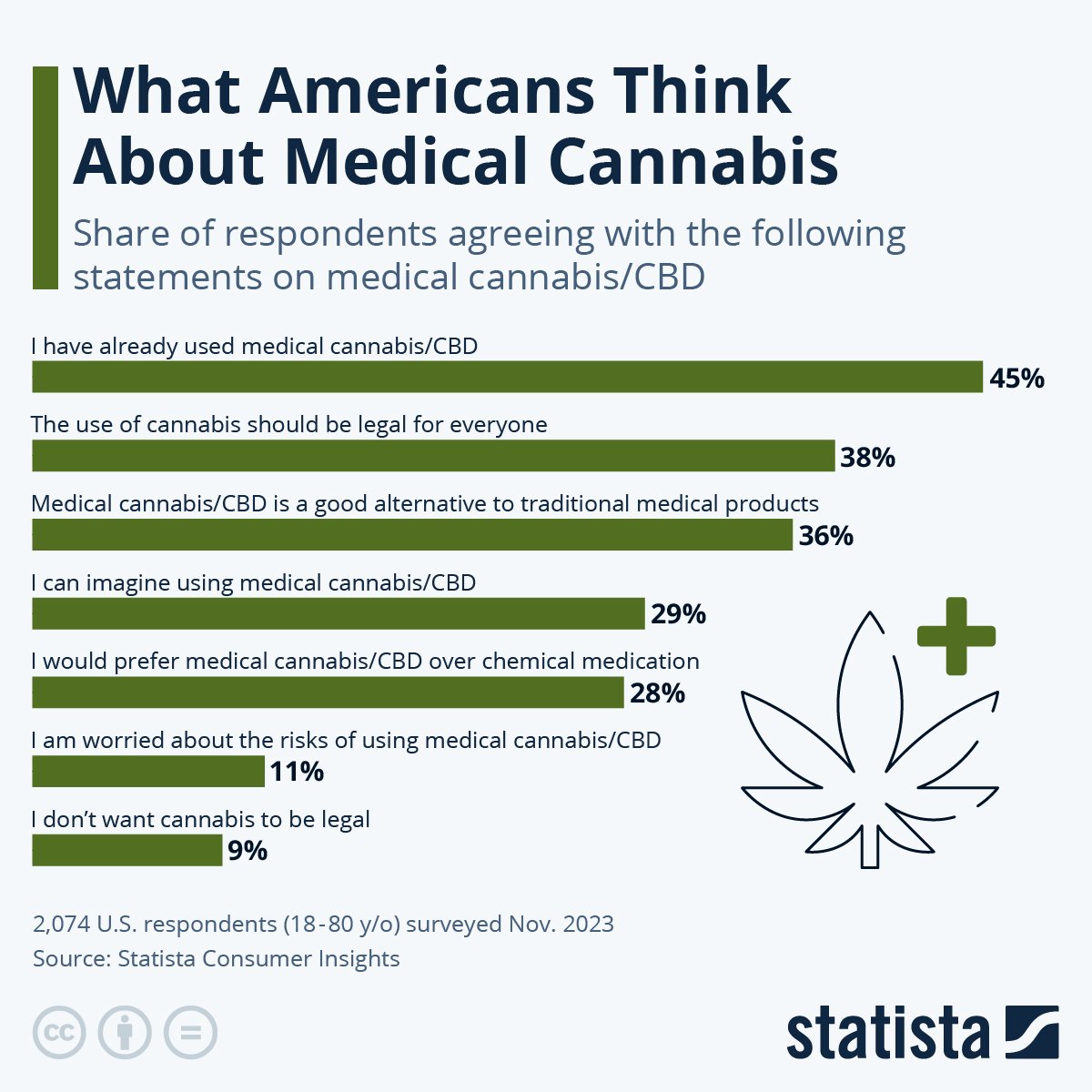
Graph: Statista Consumer Rights. "What Americans Think About Medical Cannabis." Statista, November 2023. https://cdn.statcdn.com/Infographic/images/normal/25638.jpeg